
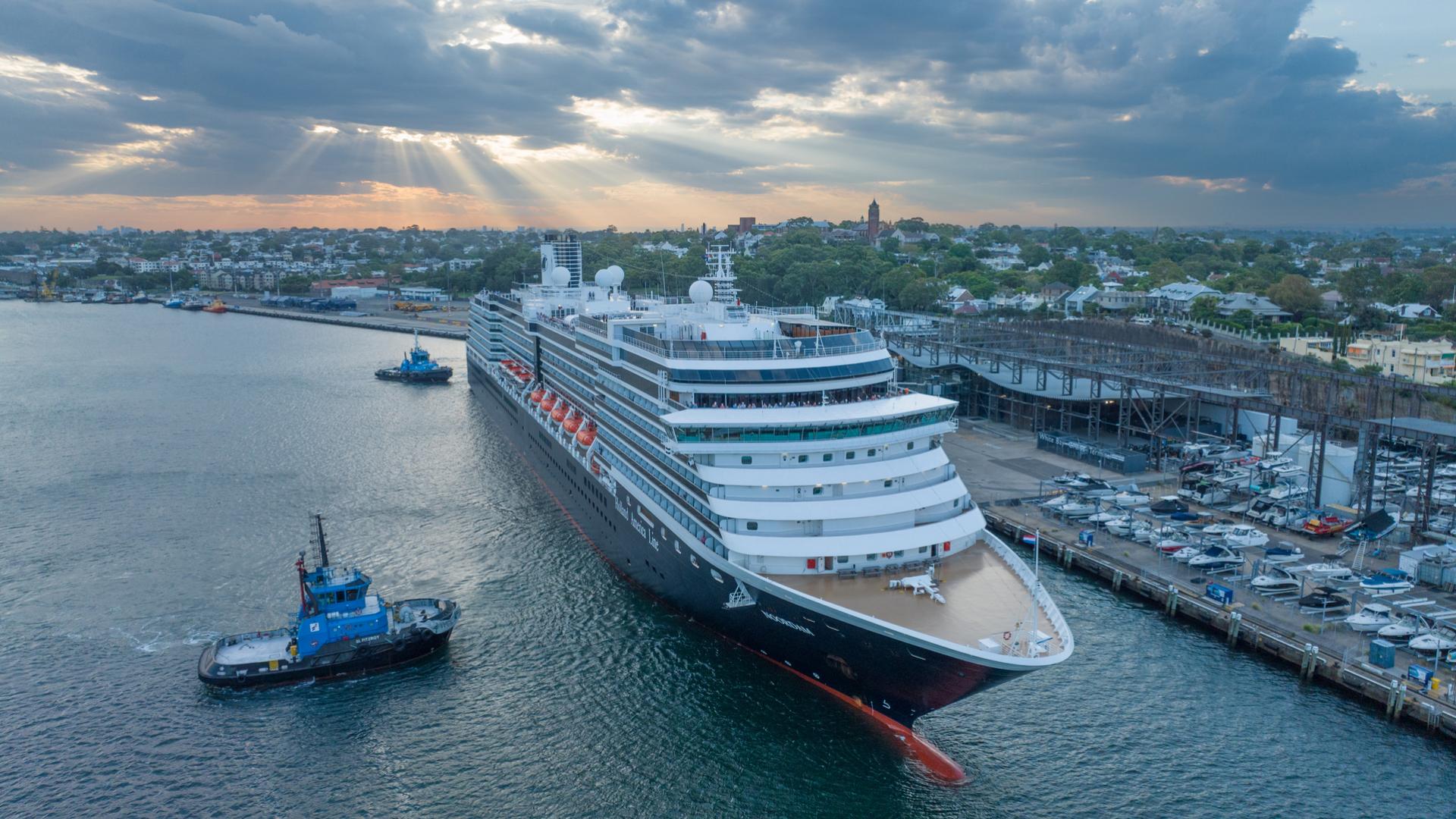
In a first in the Southern Hemisphere for a cruise terminal, Port Authority of NSW is in the process of installing and supplying Shore Power in the Bays Port precinct.
By the end of 2026, Port Authority intends to provide landside electricity supply for cruise ships at the White Bay Cruise Terminal (WBCT), which will be matched by purchased renewable electricity generation.
-
Latest updates and notifications
Read updates and notifications on our Shore Power Engage Hub
Previous updates
November 2025
Port Authority is currently carrying out civil construction works at White Bay Cruise Terminal. To support the timely and efficient delivery of the shore power infrastructure, extended construction hours will be in place for a limited period.
August 2025
Port Authority will begin site establishment works in August 2025, with temporary site offices and fencing being set up. Construction will follow in September 2025 and continue into early 2026. These works include trenching, formwork and installation of conduits and pipes along Port Access Road, Robert Street and at the White Bay Cruise Terminal.
June 2025
Site investigation works will be undertaken around White Bay in June. These investigations are crucial as preparation for the civil works that will support the future installation of electrical equipment and shore power infrastructure at White Bay Cruise Terminal.
The Addendum Review of Environmental Factors (REF) was determined in June 2025 for the seawater cooling system, which regulates the temperature of the Shore Power electrical equipment, eliminating the need for traditional air conditioning. Read about the sea water cooling system
March 2025
Initial work to prepare White Bay for the introduction of shore power is underway with the demolition of the White Bay 5 Administration and Canteen buildings between March and April 2025. The cleared space will be used to install essential electrical equipment and shore power infrastructure that will support the future shore connection at White Bay Cruise Terminal.
September 2024
Port Authority obtains planning approval for White Bay Cruise Terminal shore power installation which is another major milestone for the project. The Review of Environmental Factors (REF) required for undertaking these works is found here:
Read more information on the REF.Port Authority has awarded a $20 million contract to global leader in shore power technology, Powercon. This contract will see Powercon design, fabricate, supply and install shore power equipment at the White Bay Cruise Terminal.
Read the ministerial announcement
August 2024
Port Authority awards the contract for the major package of works in delivering the first installation in the Shore Power Project at Bays Port. It includes the design, fabrication, supply and installation of shore power equipment at White Bay Cruise Terminal (White Bay berth 5 at the Bays Port precinct), and internal electrical distribution network within the port.
This is the largest package of work and marks a significant milestone in the Bays Port Shore Power project.
-
Once a ship is safely alongside at berth, some of their engines or generators continue to run - as ships require power to carry out their operations – whether for cargo unloading or to provide electricity for the ship’s crew and passengers, including for lighting, heating and cooling, refrigeration, cooking and food preparation, and communication systems.
When ships can plug-in to renewable electricity from the shore, this allows them to power down their auxiliary engines – reducing CO2 emissions, noise and air pollution.
Video: Published 21 March 2022. The statistics mentioned in this video highlight the benefits of installing shore power infrastructure at both White Bay Cruise Terminal and Glebe Island. -
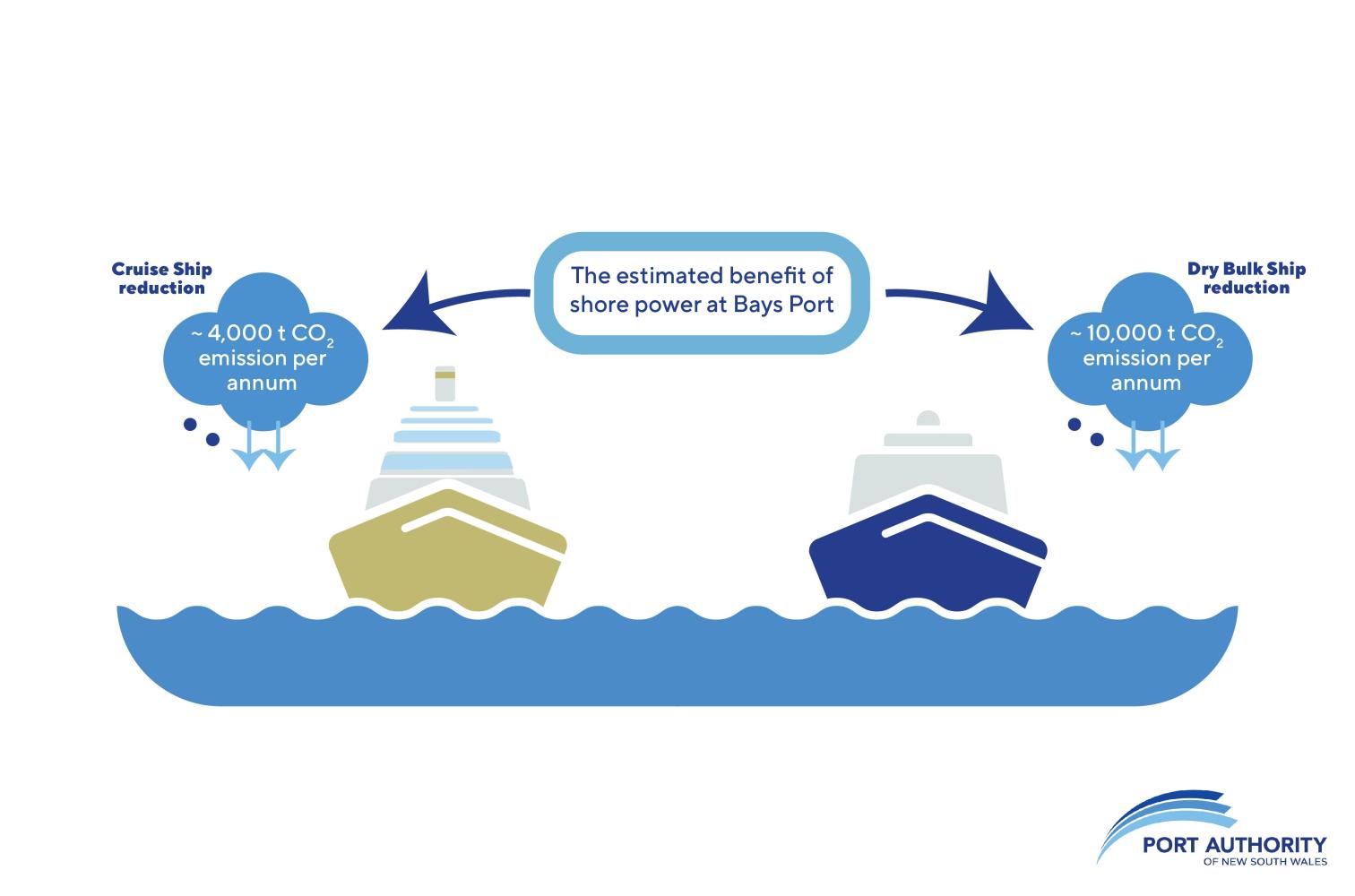
The supply of certified renewable energy for Shore Power at the White Bay Cruise Terminal is estimated to achieve a reduction of up to 4,000 tonnes of CO2 emissions per annum. This would be the equivalent to taking 1,100 cars off Sydney’s roads or planting 20,000 trees each year.
As well as the significant reduction in greenhouse gas emissions, the introduction of Shore Power could see a reduction in noise from cruise ships of up to 10dB. Powering down the ships’ engines which normally burn diesel fuel will also reduce local air pollution and associated odours.
Introducing Shore Power to Bays Port precinct is one way Port Authority is helping to contribute positively to addressing climate change and reducing impacts on the local community.
-
The development of this project wouldn’t be possible without the collaboration and support of our industry partners. Industry and government have engaged in a joint letter of intent, as the participation of both sectors is needed to ensure the successful transition to a lower emissions future.
Our valued partners Cement Australia, CSL, Carnival Cruise Line, Royal Caribbean Cruise Line and MSC Cruises are committed to the future use of Shore Power in the Bays Port precinct and will ensure that future frequently visiting ships are capable of connecting to our Shore Power facilities.
Port Authority’s plans include 5 Shore Power connection points within the Bays Port precinct – with 4 for bulk ships at Glebe Island and 1 for cruise ships at the White Bay Cruise Terminal.
-
Please read the report which outlines the considerations regarding the provision of shore power infrastructure at the Bays Port Precinct.
Pioneering Shore Power
Hear from our Port Authority team, stakeholders and industry partners on how we've arrived at this great project and what it will mean for the future.
Shore Power seawater cooling system
Our Shore Power system uses the ocean to stay cool. By drawing in seawater to regulate the temperature of its electrical equipment, it eliminates the need for traditional air conditioning when cruise ships are connected to shore power. That means less energy use, quieter operation, and a smaller environmental footprint.
Curious how it works? Dive into the details and discover how this innovative technology is powering a more sustainable future.
-
The Shore Power project at White Bay includes a closed seawater cooling system to support the Onshore Power Supply system at White Bay Cruise Terminal. The cooling system regulates the temperature of the critical electrical equipment within the Onshore Power Supply units.
It includes a set of heat exchangers, a series of pumps and filters, and intake and outlet pipes that facilitate a constant flow of seawater for cooling during the shore power operations. In developing the design for the seawater cooling system, Port Authority looked at other systems in Sydney, like the Sydney Opera House. Watch the video of our team's tour of Sydney Opera House's seawater cooling system.
The seawater cooling system replaces the need for an air conditioning system during ship-to-shore connection, which reduces electricity consumption for the project as well as minimises operational noise, particularly for nearby sensitive receivers such as residences in Balmain.
-
Seawater cooling involves the use of seawater to act as a heat exchange, transferring heat from the electrical system to seawater. Seawater is drawn from the adjacent seawater body and continually circulates during shore power connection, cooling the system.
-
Seawater is drawn directly through an intake pipe at the berth. The seawater is pumped into the system, absorbing heat as it circulates (but does not mix with the fluid or equipment that needs cooling), and is discharged back into the body of water through an outtake pipe. The discharged water will be cooled as it mixes in the wider body of water, ensuring that water intake is constantly cooled.
-
Seawater air conditioning systems have been used in Sydney’s Circular Quay since the 1960s including the Sydney Opera House and the heritage-listed AMP Palm Cove Building. Other examples include:
- Barangaroo
- Park Hyatt Hotel, Circular Quay
- Museum of Contemporary Art – Circular Quay
- Sydney Convention & Exhibition Centre – Darling Harbour
- King Street Wharf – Darling Harbour
-
Seawater cooling systems offer significant energy savings, reduced greenhouse gas emissions, and utilisation of a natural, abundant resource.
Seawater is a readily available, free and sustainable resource which can be used as a heat exchange medium. This avoids the use of conventional cooling, such as external fans, for cooling and ventilation purposes.
Using a seawater cooling system instead of air conditioning for the Shore Power system:
- reduces the amount of noise for nearby sensitive receivers
- reduces energy use (compared with a conventional cooling system during ship-to-shore connections)
- and reduces the overall environmental impact of the project.